


What Is a Facelift (Rhytidectomy)?
A facelift, clinically termed a rhytidectomy, is a surgical procedure intended to improve visible laxity, deep tissue descent, and gravitational sagging in the lower two-thirds of the face and, in most modern surgical plans, the upper neck and submental region. Rather than simply stretching the surface skin, an advanced facelift addresses the underlying foundational architecture of the face.
Over time, biological aging causes facial skin to lose elastin and type-I collagen, while the deeper structural framework—the superficial musculoaponeurotic system (SMAS) and facial retaining ligaments—stretches and descends. Fat compartments also atrophy and shift downward, causing the characteristic flattening of the cheeks, the accumulation of jowls along the jawline, and the deepening of folds between the nose and mouth.

Anatomical Components of Modern Facelift Surgery
Depending on the individual patient's specific facial morphology, skin quality, and aesthetic goals, the surgical intervention typically encompasses:
SMAS Repositioning & Suspension
Tightening or repositioning deeper facial support tissues (SMAS) to bear the mechanical lifting tension rather than relying on skin tension alone.
Tension-Free Skin Redraping
Redraping the overlying skin naturally with minimal mechanical tension to ensure smooth healing, discreet scars, and completely natural facial animation.
Conservative Excess Skin Excision
Measuring and resecting carefully planned redundant skin along natural auricular creases without distorting the sideburns or natural tragal architecture.
Mandibular & Neck Definition
Smoothing descended jowl fat and tightening lax submental platysma muscles to restore a clean, youthful 90–105 degree cervicomental angle.
Facelift versus Non-Surgical Treatments
Patients in Lucknow frequently ask whether advanced non-surgical modalities can replace a surgical facelift. Non-surgical options offer valuable, subtle enhancements for early or mild signs of facial aging. However, they operate on different biological mechanisms and cannot reproduce the comprehensive multi-planar structural tissue repositioning achieved by surgical rhytidectomy.

The Spectrum of Non-Surgical Facial Rejuvenation
Depending on clinical assessment, non-surgical approaches may include:
- Botulinum Toxin: Relaxes hyperdynamic expression muscles (crows feet, forehead lines, platysma bands).
- Dermal Fillers: Restores localized volume in temples, malar cheeks, and tear troughs.
- Energy-Based Devices: High-Intensity Focused Ultrasound (HIFU) and Monopolar RF for dermal tightening.
- Fractional Resurfacing & Peels: Targets pigmentation, photodamage, and superficial textural crepiness.
A reputable cosmetic clinic will objectively counsel patients when non-surgical treatments are appropriate, and transparently explain when structural laxity has progressed to the point where non-surgical devices would produce disappointing results.
Facelift versus Facial Fat Transfer
Facial aging is fundamentally a two-fold biological process involving both tissue descent (gravitational laxity) and volume depletion (lipoatrophy). Patients often experience hollow temples, sunken tear troughs, and flattened mid-face cheeks alongside lower face jowls and neck laxity.

| Factor | Surgical Facelift | Autologous Fat Transfer |
|---|---|---|
| Primary Mechanism | Repositioning descended SMAS & resecting loose skin | Restoring lost structural adipose volume and stem cells |
| Target Concerns | Jowls, drooping cheeks, neck laxity, blunted jawline | Hollow temples, sunken tear troughs, flattened mid-face |
| Skin Removal | Yes, planned excision of redundant lax skin | No, does not remove skin; fills deflation hollows |
| Combination Potential | Often combined synergistically: the facelift lifts fallen tissues while micro-fat grafting restores youthful three-dimensional volume. | |
Face Skin Lift: What Patients Should Know
The phrase “Face Skin Lift” has become one of the most widely searched terms among prospective patients seeking to improve facial sagging, loose skin, and jowls in Lucknow. In clinical practice, however, this colloquial phrase does not refer to a single standardized medical procedure.
Depending on which clinic a patient visits, “Face Skin Lift” might refer to a comprehensive deep-plane facelift, an ambulatory mini facelift, a non-surgical thread lift, or an energy-based ultrasound session. Because these interventions vary widely in surgical invasiveness, recovery downtime, longevity, and cost, patients must understand the anatomical distinctions.

Anatomical Anatomies Improved by a Surgical Lift
A properly indicated surgical face skin lift works on tissues beneath the skin surface, systematically addressing:
Elevating the descended malar fat pad back to the zygomatic arch to restore natural cheek fullness.
Eliminating the interruption along the lower jawline caused by sagging fat and skin redundancy.
Smoothing crepey excess skin folds around the mouth, chin, and perioral zones.
Tightening the platysma muscle to resolve vertical cords and “turkey neck” looseness.
Restoring sharp, refined demarcation between the lower jaw and the anterior neck.
Relieving the heavy overhang creating deep nasolabial and marionette creases.
Why Facelift Consultation Matters
A generic online query such as “best facelift surgeon in Lucknow” cannot assess your skin elasticity, micro-vascular circulation, facial symmetry, or personal health profile. The in-person consultation is the cornerstone of safe, ethical, and effective facial surgery.

Key Consultation Questions Every Surgeon Should Clarify
Surgical versus Non-Surgical Suitability
Whether the patient's concern is truly structural laxity requiring surgical repositioning or surface aging treatable with energy devices.
Precise Anatomical Vectors & Dissection Plane
Which anatomical zones will be treated (SMAS plication, SMASectomy, deep plane, or platysmaplasty).
Realistic Degree of Aesthetic Improvement
Clear visual communication regarding what degree of tightening looks natural and what would appear over-done.
Incision Design & Scar Concealment
Exact mapping of where incisions will sit relative to the tragus, earlobe, and temporal hairline.
Personalized Risk & Recovery Schedule
Individualized analysis of healing speed, nicotine history, blood pressure management, and return-to-work timeline.
Facial Skin Lift Options in Lucknow: Surgical & Non-Surgical
The best option depends on the root cause of facial concerns. Skin texture, facial volume, dynamic muscle activity, adipose distribution, and deeper muscular descent all require tailored clinical approaches. Below is the clinical comparison matrix used by our surgical team:
| Treatment Option | Common Purpose | Typical Level of Change | Key Considerations |
|---|---|---|---|
| Surgical Facelift | Improve significant lower-face laxity and jowls | More Substantial | Requires anaesthesia, incisions, recovery downtime, and surgical risk management. |
| Mini Facelift | Address selected early-to-moderate laxity | Moderate | May not address advanced neck laxity or extensive tissue descent. |
| Neck Lift | Improve loose neck skin and muscle laxity | Substantial | May be performed as a standalone or combined with a lower facelift. |
| Thread Lift | Temporary lifting effect in selected cases | Limited to Moderate | Results vary (6–12 months) and are not structurally equivalent to a facelift. |
| Energy-Based Tightening | Improve mild laxity and firmness (HIFU/RF) | Subtle to Moderate | Gradual collagen stimulation; results vary by device settings and tissue quality. |
| Dermal Fillers | Restore selected areas of lost volume | Localized | Does not remove excess skin; overfilling produces unnatural puffiness. |
| Fat Transfer | Add volume using patient's own purified fat | Localized to Broader | Some transferred fat cells may not survive; stable body weight required. |
| Skin Resurfacing | Improve texture, fine lines, or sun damage | Surface-Focused | Does not correct major underlying tissue sagging or jowl formation. |
Who May Be a Candidate for a Facelift?
Candidacy is evaluated individually during consultation rather than dictated by chronological age alone. Some patients develop tissue laxity in their late thirties due to genetics, smoking, or weight fluctuations, while others retain favorable skin elasticity into their sixties.
Ideal Candidate Characteristics
- •Noticeable sagging in the cheeks, jowls, or lower facial third.
- •Loose, redundant skin along the mandibular border or upper neck.
- •Realistic aesthetic expectations aligning with anatomical possibilities.
- •Stable general health with well-controlled systemic parameters.
- •Non-smoker or willing to undergo verified nicotine cessation.
Medical Optimization Required
- •Active tobacco or nicotine vaping (severely impairs microvascular healing).
- •Uncontrolled diabetes mellitus or severe cardiopulmonary illness.
- •Bleeding diatheses or non-disclosed anticoagulant therapy.
- •Active facial cutaneous infections or unmanaged severe acne.
- •Unrealistic expectations driven by digital filters or external pressure.
Non-Surgical Facelift Modalities: What They Do & Realistic Limits
There is no single “best” non-surgical facelift method for everyone. The appropriate protocol depends on skin thickness, laxity severity, adipose distribution, and downtime constraints. Below are the primary non-surgical approaches:


1. Energy-Based Skin Tightening (HIFU, Monopolar RF, Fractional Lasers)
These platforms deliver controlled thermal energy (60–70°C) to the reticular dermis and superficial SMAS, inducing immediate collagen contraction followed by secondary neocollagenesis over 3 to 6 months. Ideal for early laxity and mild jowling; however, they cannot resect loose excess skin.
2. Thread Lifts (PDO / PLLA Barbed Sutures)
Polydioxanone (PDO) or Poly-L-lactic acid (PLLA) barbed threads are introduced via blunt cannulae into the subcutaneous plane to exert mechanical suspension. Results typically last 6 to 12 months. Risks include suture visibility, palpability, asymmetry, and extrusion.

3. Injectable Biostimulators & Dermal Fillers
Biostimulatory agents (Poly-L-Lactic Acid or Calcium Hydroxylapatite) trigger fibroblasts to produce type-I collagen gradually. Dermal fillers restore lost bone and fat pad volume. While they enhance facial balance, over-filling in an attempt to “lift” heavy sagging results in an unnatural, puffy appearance.
Types of Facelift Procedures
Facelift techniques vary according to anatomical requirements, tissue laxity severity, and surgeon specialization. Key surgical categories include:


Traditional or Full SMAS Facelift
Addresses extensive lower-face, mid-face, and upper-neck laxity. Incisions curve around the temporal hairline, follow the pre-auricular crease, and extend behind the earlobe. The surgeon mobilizes the SMAS layer to reposition fallen fat compartments and redrapes the skin without tension.
Mini Facelift (Limited-Incision S-Lift)
Designed for patients with early-to-moderate lower-face laxity who do not require extensive neck surgery. Utilizes shorter incisions restricted to the anterior ear crease, offering quicker recovery (5–7 days).
Deep-Plane Facelift
An advanced technique where the surgeon releases the deep retaining ligaments directly beneath the SMAS. This allows the malar fat pad and midface to be elevated tension-free, producing profound mid-face and jawline definition without skin tightness. Requires specialized surgical mastery.
Dedicated Neck Lift (Platysmaplasty)
Focuses on submental fat deposits and separated platysma muscle cords. The platysma muscle edges are sutured together like a corset (corset platysmaplasty) through a discreet 2-3 cm submental incision under the chin.
How Facelift Surgery Is Performed
From initial sterile draping to postoperative recovery, facelift surgery follows a meticulous, multi-stage clinical pathway in an accredited operating theatre:

Preoperative Markings & Consultation Review
Standing markings are meticulously mapped with the patient upright to account for gravitational vectors on cheeks, jowls, and neck bands.
Anaesthesia Administration
Performed under general anaesthesia or twilight sedation with local tumescent infiltration, administered by a dedicated MD Anaesthesiologist.
Anatomical Incisions
Incisions are placed discreetly inside the temporal hairline, along the tragal contour, around the earlobe, and into the retro-auricular sulcus.
SMAS Elevation & Deep Tissue Plication
The deep SMAS muscular layer is elevated and anchored vertically, releasing retaining ligaments to reposition the underlying facial framework.
Skin Redraping & Conservative Excision
The skin flap is redraped passively over the newly elevated contours. Redundant skin is conservatively trimmed with zero tension on wound edges.
Micro-Suture Closure & Supportive Dressing
Layered closure using delicate micro-sutures to ensure imperceptible scar lines. Soft compression dressings are applied to support healing.
Benefits of a Facelift & Vector Architecture
The ultimate goal of modern facial rejuvenation is a rested, vibrant, and natural appearance—never an over-tightened, artificial, or “pulled” look. Achieving this requires strict adherence to vertical vector physics.

Refined Jawline Demarcation
Restores the unbroken, clean linear contour of the mandible by eliminating jowl overhang and tissue descent.
Preservation of Expression
By isolating lifting tension strictly to deep SMAS layers, surface facial animation and smiling muscles remain completely natural.
Durable 8–12+ Year Longevity
Provides significantly greater aesthetic endurance than temporary thread suspensions or annual non-surgical energy rounds.
Balanced Face-to-Neck Harmony
Ensures both the lower face and cervical regions age synchronously without an obvious mismatch between jaw and neck.
Risks, Possible Complications & Emergency Protocols
All surgical procedures carry inherent risks. Even when performed by an experienced plastic surgeon in an accredited hospital, complications can occur. Ethical surgical practice requires full disclosure and proactive risk management:
Haematoma Alert: Urgent Symptoms Requiring Immediate Medical Attention
A haematoma is a collection of blood that develops under the skin, most commonly within the first 24 to 48 hours post-op. Patients are provided with a 24/7 direct surgical emergency line. Contact the surgical team immediately if you notice:
- • Rapidly increasing swelling on one side of the face or neck
- • Severe, throbbing pain unmitigated by prescribed medication
- • Active, continuous bleeding from incision lines
- • High fever, spreading redness, or foul discharge
- • Shortness of breath, chest pain, or calf swelling
- • New or sudden facial muscle weakness
Facelift Preparation & Pre-Booking Checklist
Comprehensive preoperative preparation significantly enhances safety and smooths the recovery curve:
Medications & Lifestyle
- • Discontinue all tobacco and nicotine products 4–6 weeks prior.
- • Pause aspirin, ibuprofen, vitamin E, ginkgo biloba, and garlic supplements under doctor guidance.
- • Disclose all prescription medications, hypertension, or thyroid drugs.
- • Maintain stable body weight and balanced nutrition.
Home & Logistical Setup
- • Arrange for an adult caregiver to escort you home and stay for 48 hours.
- • Prepare button-down clothing (avoid pullovers that touch the face).
- • Stock soft foods, extra pillows for 40° head elevation, and cold compresses.
- • Pre-fill all prescribed analgesics and antibiotic ointments.
Facelift Recovery Timeline: Day 1 to Month 12
Recovery is an evolving biological process. Most patients can see clear improvements in facial contours within the first few weeks, but the final outcome continues refining over 6 to 12 months as swelling settles and scars soften:
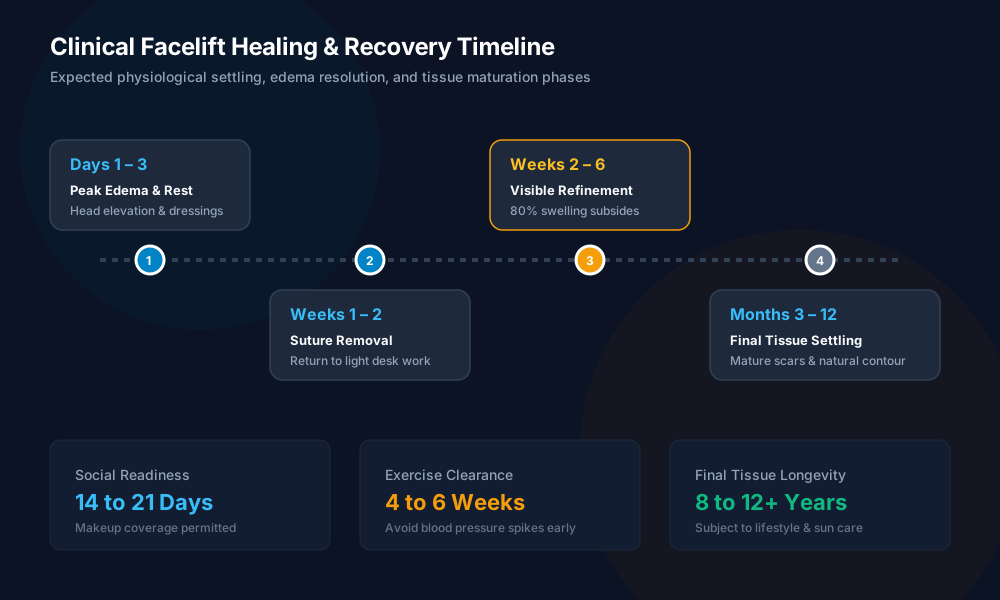
Swelling, bruising, and tightness peak around 48 to 72 hours. Sleep strictly elevated on 2 to 3 pillows. Avoid bending over or strenuous exertion. Temporary asymmetrical swelling is completely normal during this window.
Pre-auricular sutures are typically removed between days 5 and 7; hairline sutures between days 10 and 12. Most patients return to light desk-based work at 10 to 14 days, using light camouflage makeup.
Roughly 80% of visible edema resolves. Tissue tightness eases. Light cardiovascular exercise (walking, stationary cycling) may resume upon surgeon clearance. Avoid contact sports or heavy weightlifting.
At 3 months, you achieve a reliable outcome view. By 6 to 9 months, deep tissue softening is complete. By 12 months, incisions mature into fine silvery traces and nerve sensation returns fully.
Scars After Facelift Surgery: Placement & Care
Scars are an unavoidable consequence of any surgical incisional procedure. However, a skilled plastic surgeon places incisions in natural anatomical shadow lines—such as the margin of the tragus and the post-auricular sulcus—so that they are virtually imperceptible once mature.
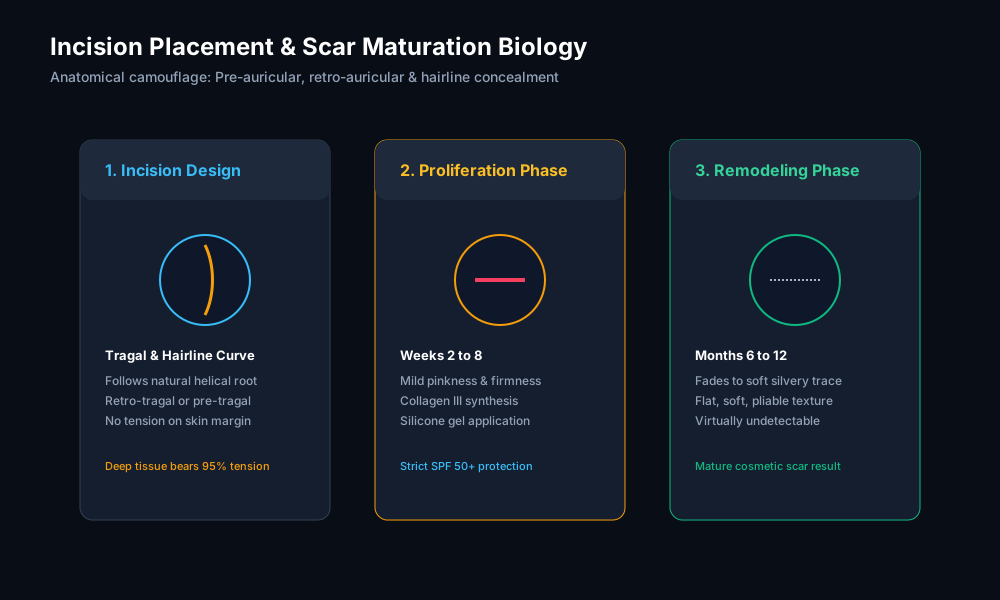
Factors That Optimize Scar Quality:
- Tension-Free Closure: The deep SMAS absorbs 95% of tension; the skin is closed under zero pull.
- Silicone Scar Therapy: Medical-grade silicone gel is introduced once incisions fully close.
- Rigorous UV Blockade: SPF 50+ prevents melanin hyperpigmentation along pink healing margins.
- Nicotine Avoidance: Preserves micro-capillary oxygenation to prevent wound dehiscence.
Facelift Cost in Lucknow: Transparent Financial Breakdown
The cost of facelift surgery in Lucknow is shaped by surgical complexity, hospital facility tier, anaesthesia provision, and post-operative care packages. An ethical clinic provides an all-inclusive, itemized quote following an anatomical consultation:
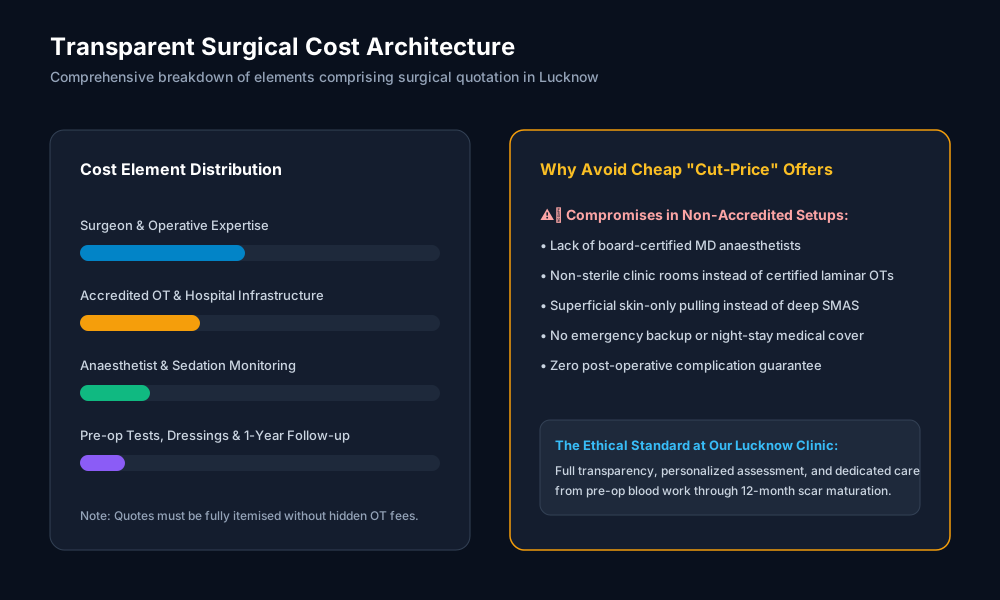
Elements That Legally Influence Surgical Fees in Lucknow:
- • Surgical technique (Mini vs SMAS vs Deep Plane)
- • Concomitant neck lift or platysmaplasty
- • Micro-fat grafting volume requirements
- • Hospital OT laminar airflow and sterile consumables
- • Dedicated MD Anaesthesiologist supervision
- • Routine post-op checks and scar care for 12 months
Lucknow Regional Care: Local Neighborhoods & Outstation Patients
Lucknow has rapidly established itself as the leading tertiary aesthetic medical destination in Uttar Pradesh. Patients frequently travel from surrounding cities for premier facial plastic surgery:
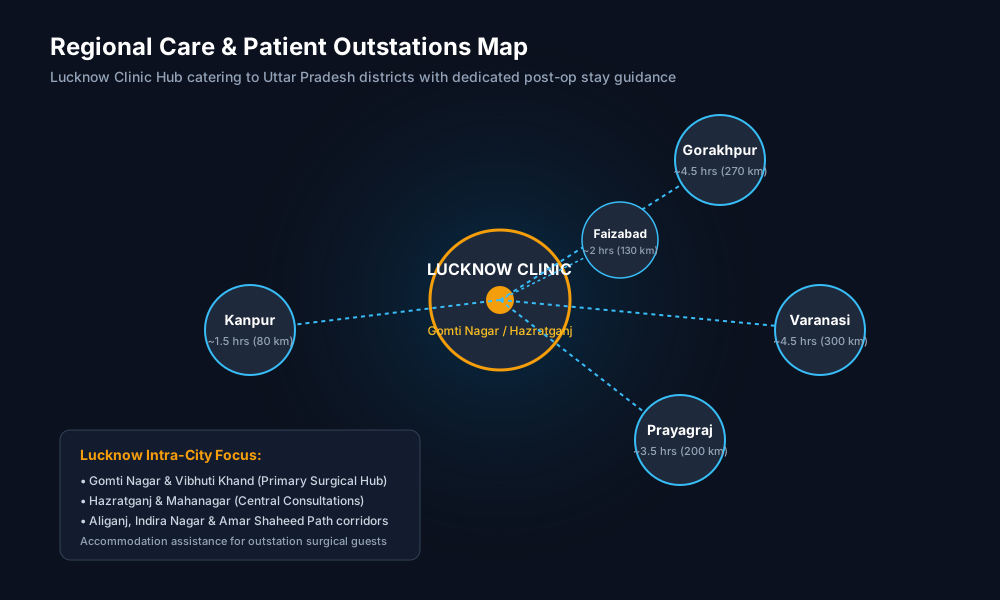
Outstation Patient Stay Recommendations:
Patients traveling from Kanpur (80 km), Prayagraj (200 km), Varanasi (300 km), or Gorakhpur (270 km) are advised to arrive 1–2 days prior for medical clearance and plan to stay near Gomti Nagar or Hazratganj for 7–10 days post-operatively until initial sutures are painlessly removed.
Choosing a Facelift Clinic in Lucknow: Quality Criteria & Red Flags
Cosmetic surgery requires high precision and comprehensive safety measures. Do not base your decision solely on discounted prices or social media promotions:
Essential Verification Checklist
- ✓ Surgeon holds recognized MCh or DNB Plastic Surgery qualifications.
- ✓ Clear experience with deep-plane, SMAS, and neck anatomy.
- ✓ Operation performed in an accredited surgical suite with full backup.
- ✓ Dedicated MD Anaesthesiologist present throughout the surgery.
- ✓ Transparent, unpressured consultation explaining risks openly.
Warning Red Flags to Avoid
- ⚠️ Promises of “permanent” anti-aging or “scarless” surgery.
- ⚠️ High-pressure booking tactics or limited-time discount countdowns.
- ⚠️ Consultation conducted only by salespeople without meeting the surgeon.
- ⚠️ Refusal to detail emergency backup arrangements or revision policies.
- ⚠️ Suspiciously low pricing omitting hospital and anaesthesia fees.
Facelift & Dermatological Skincare Synergy
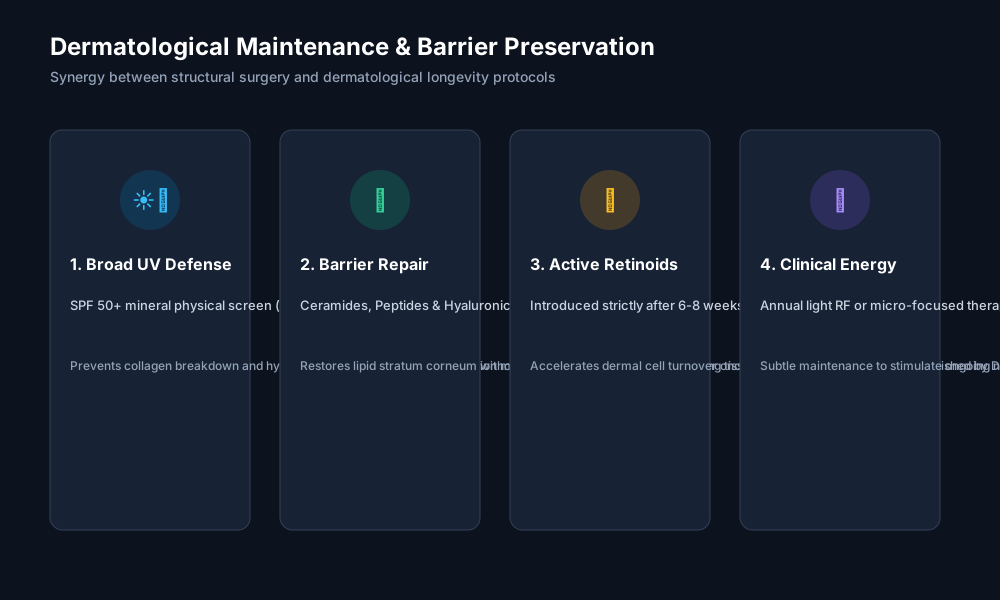
Surgery repositions deep tissues and eliminates excess skin, but it does not alter cellular dermal quality, pore dilation, or epidermal sun damage. Combining surgical contouring with structured dermatological skincare ensures enduring, luminous results:
Facelift for Men versus Women: Anatomical Nuances
Facelift planning must respect gender-specific anatomical characteristics rather than applying a uniform approach:
Male Patients: Considerations
Men have significantly thicker dermis, richer subdermal capillary networks (requiring meticulous haematoma control), and beard-bearing skin. Incisions must preserve the natural sideburn and prevent hair follicles from being pulled onto the ear tragus.
Female Patients: Considerations
Women often present with thinner skin and higher rates of mid-face volume loss. Incisions can be placed retro-tragally inside the ear canal for near-invisible camouflage, allowing seamless hairline concealment when styling hair up.
Facelift for Different Age Groups
Age is never an absolute determinant of candidacy. Indications depend on physiological skin quality and anatomical descent:
Early jowl formation and midface descent. Often ideal candidates for Mini Facelift, targeted S-lift, or combined non-surgical HIFU with micro fat transfer.
The classic window for comprehensive SMAS or deep plane rhytidectomy combined with neck lift (platysmaplasty) for comprehensive rejuvenation.
Eligible provided cardiovascular and systemic health are optimal. Focuses on safe lower face and neck contouring to match an active, energetic lifestyle.
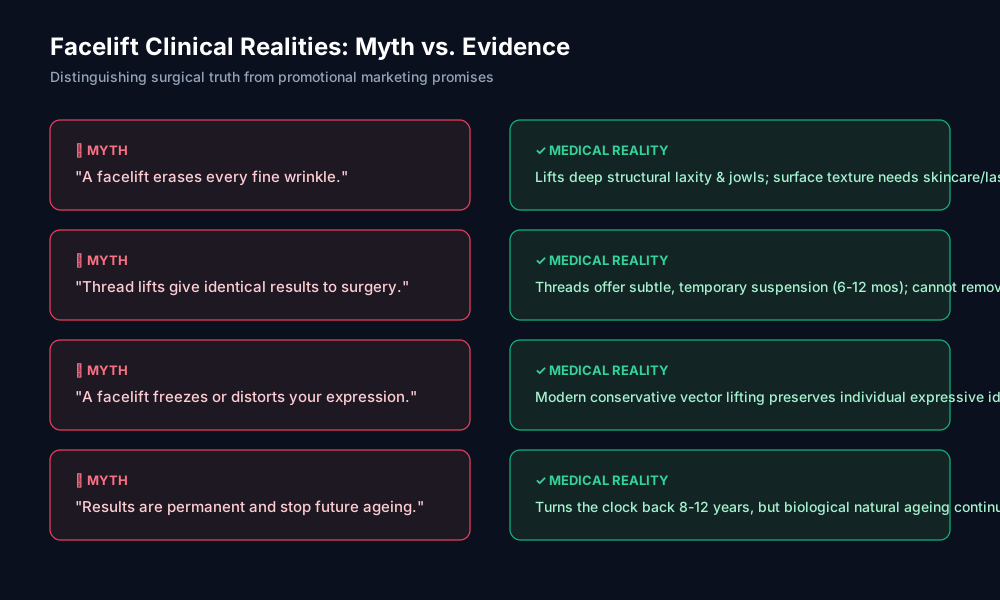
Common Myths About Facelift Surgery Debunked
Promotional claims and outdated stereotypes frequently mislead patients. Here are the clinical facts:
Your Consultation at a Lucknow Facelift Clinic
A consultation is the single most important step before deciding on facial rejuvenation. Bring a complete list of medical conditions, past surgeries, prescription medicines, and previous cosmetic treatments. During your visit, discuss your goals in practical terms—identifying specific concerns such as jowls, loose neck skin, or cheek deflation.
Ready to Explore Your Facial Rejuvenation Options?
Schedule a comprehensive consultation with our facelift surgical team in Lucknow. Discuss facial laxity, jowls, neck contours, skin quality, and suitable surgical or non-surgical options in complete confidence.